
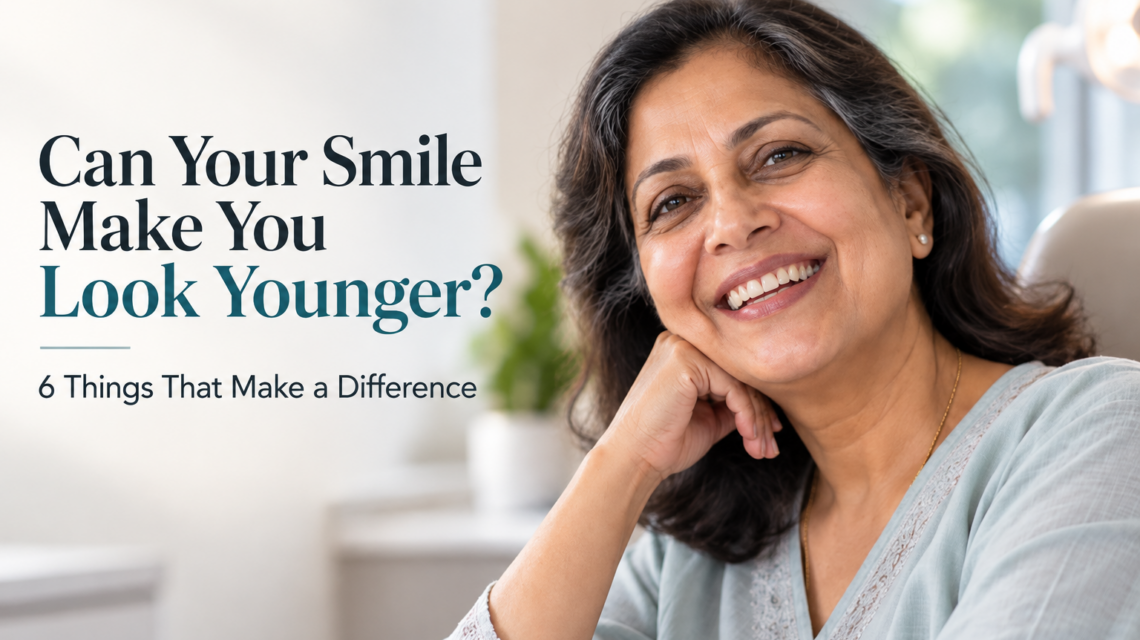
When we think about looking younger, we usually think about our skin, hair or fitness. But there is another feature that can subtly change how old we look – our smile
As we age, our teeth and gums change too. Teeth may become darker, edges can wear down, gums may recede, and dental restorations that looked good years ago may start showing their age. Even small changes in the teeth can affect the way the lips and lower face are supported.
The good news is that creating a younger-looking smile does not necessarily mean completely changing it. Very often, it is about bringing back the healthier, fresher features that have gradually been lost over the years.
Here are six things I look at when evaluating a smile.
1. Well-Aligned Teeth
Well-positioned teeth naturally make a smile look more harmonious.
Crowding, overlapping teeth, rotations or an uneven smile line can make the smile appear less balanced. Depending on the situation, orthodontic treatment, aligners or carefully planned cosmetic dental treatment can improve the alignment.
The goal should not always be perfectly straight, identical-looking teeth. A little individuality makes a smile look natural. What we want is *better alignment and better overall balance*
2. Replace Dental Work That Has Aged
Dental restorations age just like natural teeth.
An old crowns may no longer match the neighbouring teeth. Fillings can become stained at their margins, and older crowns may look opaque, grey or have visible dark margins near the gums.
The same applies to dentures. Teeth on an older denture can become worn, stained or less flattering to the face, while changes in the underlying gums and bone can affect its fit and facial support.
This doesn’t mean every old restoration needs replacing. *If it is healthy, functional and looks good, there may be no reason to change it.* But when old dental work is affecting your smile, replacing it with a well-planned restoration can make a noticeable difference.
3. Restore Worn-Down Teeth
This is one of the changes people often don’t notice happening.
Over the years, teeth can gradually become shorter and flatter. Bruxism — clenching or grinding — can accelerate this process. The natural curves and edges of the teeth slowly disappear.
And when teeth lose length, it isn’t only the teeth that look different. Significant wear can also influence the overall proportions of the smile and, in some cases, the support of the lower face.
Restoring worn teeth is not simply about making them longer. We first need to understand *why the wear happened* and then decide whether the teeth need protection, restoration or both.
4. A Little Brighter Can Look Younger
Our teeth naturally tend to become darker with age.
Years of tea, coffee,wine, smoking, food pigments and changes within the tooth itself can make the smile appear more yellow, greyish or dull.
Sometimes, all that is needed is a professional cleaning and polishing to remove surface stains. In other cases, professionally supervised teeth whitening may help achieve a lighter shade.
The key word here is natural
The aim isn’t necessarily to have extremely white teeth. A clean, healthy-looking shade that suits your complexion and age often looks far better than an unnaturally white smile.
5. Healthy Gums Matter Just as Much as Teeth
A beautiful smile isn’t only about the teeth. The gums are their frame.
Healthy gums should generally look firm and healthy, coral pink and without persistent swelling or bleeding. With gum disease, aggressive brushing and other factors, the gums may recede and expose more of the tooth or root.
This can make teeth appear longer and change the proportions of the smile.
Regular dental examinations, professional cleaning when required and good brushing and interdental cleaning at home are therefore an important part of maintaining a younger, healthier-looking smile.
And if you notice bleeding gums, don’t simply ignore them because there is no pain.
Bleeding can be an early sign that your gums need attention.
6. Don’t Forget the Lips and Facial Support
Your teeth don’t exist in isolation. They are part of your face.
The position and length of the teeth, missing teeth, the bite and the fit of a denture can all influence how the lips and lower face are supported.
This becomes particularly important when we are designing dentures or carrying out a more extensive smile rehabilitation. We don’t just look at the teeth on a dental model. We need to see how those teeth look when you smile, speak and relax your face
The lips themselves also frame the smile. Keeping them healthy and hydrated and, if you choose to wear lipstick, selecting a shade that compliments your teeth can change the overall appearance of your smile surprisingly well.
So, What Makes a Smile Look Younger?
It isn’t simply white teeth.
A youthful-looking smile is usually a combination of well-positioned teeth, appropriate tooth length and shape, healthy gums, natural-looking restorations, a pleasant tooth shade and good support for the lips and face.
Most importantly, treatment should still look like you.
Good dentistry should not leave every patient with exactly the same smile. The aim is to understand what has changed, what actually needs treatment and what should be left alone.
Sometimes the biggest improvement comes from a very small change.
Every smile and dental condition is different. A clinical examination is necessary before deciding whether whitening, orthodontics, replacement of restorations or restorative treatment is appropriate for you.